Indexed Universal Life Insurance Explained
Indexed Universal Life Insurance Explained
So what is IUL insurance? Indexed universal life insurance explained: it's one of the more flexible permanent life insurance options, combining a death benefit with a cash value component tied to a market index such as the S&P 500. This hybrid policy offers both protection and the potential for tax-free cash value growth, with mechanisms like cap and floor rates limiting gains and losses to manage risk. Families and business owners throughout Northern Virginia trust indexed universal life to provide flexible premiums, protect legacies, and build long-term wealth accumulation.
Key Takeaways
- Indexed universal [life insurance](https://vipinsures.com/vip-insures-life-insurance) combines permanent life coverage with tax-advantaged cash value growth linked to stock market performance.
- IUL policies feature flexible premium options that adapt to changing financial situations while enabling wealth accumulation through indexed account returns without triggering annual taxes.
- Downside risk protection within indexed universal life policies shields cash value from market losses during downturns and economic volatility.
- VIP Insures, based in Sterling, VA, specializes in helping Northern Virginia families secure permanent protection and tax-efficient wealth accumulation through tailored indexed universal life insurance solutions.
- Explore more about general life insurance and term life insurance options to understand how indexed universal life fits into your overall coverage strategy.
What Is Indexed Universal Life Insurance, Exactly?
Indexed universal life insurance is one of several permanent life insurance options, designed to provide lifelong protection combined with a savings element whose growth is linked to a stock market index. Unlike term life insurance, which offers coverage for a fixed period, an IUL policy remains in force as long as premiums are paid and accumulates cash value over time. This cash component can grow by tracking market indices like the S&P 500, offering an opportunity for higher returns compared to fixed-rate whole life insurance.
The best iul policy guide highlights three defining features of indexed universal life insurance:
- Permanent coverage: Offers lifetime protection rather than a limited term.
- Flexible premiums: Payment amounts and schedules can adjust to meet changing budgetary needs.
- Indexed cash value growth: Cash value growth is tied to the performance of a market index, with built-in tax advantages.
That combination sets indexed universal life apart from simpler life insurance products, blending protection, growth potential, and flexibility into one policy.
How Does an Indexed Policy Differ From Whole Life?
While whole life insurance typically grows cash value at a fixed, guaranteed rate, indexed universal life insurance growth is linked to market performance through an index. This allows for potentially greater returns in strong market years. Additionally, IUL policies provide more flexible premium payment options, unlike the fixed premiums associated with whole life insurance, therefore accommodating changing financial circumstances better.
Why Does Location Matter When Choosing a Policy?
Selecting a local agency familiar with your region’s financial climate is crucial for receiving personalized guidance. VIP Insures is headquartered in Sterling, VA, right in the heart of Northern Virginia and the DC Metro area. This proximity allows the agency to offer tailored advisory services, understanding unique local costs of living and planning requirements.
Because every family's needs differ, VIP Insures emphasizes customized life insurance policies rather than one-size-fits-all packages. Their approach includes comprehensive comparisons of indexed universal life insurance against other permanent options, supporting both business owners and households in making informed decisions about their long-term financial protection.
How Does the Cash Value Actually Grow in Indexed Universal Life Insurance?
Understanding how IUL works starts with cash value. The cash value within an index universal life insurance policy earns interest based on the performance of a stock market index, most commonly the S&P 500, driving IUL cash value accumulation over the life of the policy. Instead of accruing cash value at a fixed rate, the growth is subject to cap and floor rates that effectively set an upper and lower limit on returns. This means that while strong market years can boost the cash value up to the cap, poor market years are cushioned by the floor, preventing losses.
What Do the Cap and Floor Actually Do in Indexed Universal Life?
The floor functions as a safety net that protects the policyholder’s cash value from negative index returns, ensuring that losses are minimized or eliminated when the market declines. The cap, or participation rate in some policies, limits the maximum credited interest during positive market performance years, controlling the upside potential. Together, these mechanisms produce a moderated return range that shields policyholders from extreme market swings.
For Northern Virginia families evaluating an iul policy guide, these cap and floor features highlight important differences in cash value growth compared to traditional products:
- Indexed universal life insurance: cash value fluctuates within defined cap and floor ranges based on market index performance annually.
- Whole life insurance: cash value grows predictably on a fixed schedule with fixed premiums, providing steady but potentially lower growth.
Choosing between these options depends on the household’s appetite for growth potential versus a preference for predictable, guaranteed accumulation, especially in legacy and estate planning.
VIP Insures offers a personal touch as a boutique two-person agency, guiding clients through the nuances of caps, floors, and index crediting tailored to their exact policy performance scenarios rather than generic sales pitches.
Numerical Example Illustrating Indexed Universal Life Cash Value Growth with 0% Floor and 10% Cap
Consider a policyholder with a starting cash value of $100,000 in an indexed universal life insurance policy featuring a 0% floor protection (meaning no losses credited in down markets) and a 10% annual cap on gains. Below are two scenarios based on S&P 500 performance:
- Scenario 1: S&P 500 Gains 15%Since the cap is 10%, the credited interest to the cash value will be limited to 10%. The cash value increases from $100,000 to $110,000.
- Scenario 2: S&P 500 Declines 10%Due to the 0% floor, the policy’s cash value does not decrease. The cash value remains at $100,000, effectively shielding the owner from the negative market impact.
Over time, this structure offers protection during downturns while still enabling the cash value to grow during positive market years, though capped. This moderated growth dynamic is an essential feature explored in any iul policy guide for prospective buyers.
Understanding Costs, Fees, and Risks of IUL Policies
Indexed Universal Life insurance policies carry a variety of costs and fees that potential buyers should carefully consider to ensure informed financial planning. These costs can affect the cash value growth and overall performance of the policy.
- Cost of Insurance (COI): This is the primary charge related to the death benefit protection. The COI increases with the insured’s age and the amount of coverage. It is deducted from the policy’s cash value and can fluctuate annually.
- Administrative Fees: Policies often include monthly or annual fees to cover the insurer's administrative expenses. These fees vary by insurer and can impact the cash accumulation.
- Premium Load Fees: Some policies apply premium load or sales charges when premiums are paid, reducing the amount credited to the cash value. Understanding these fees is essential for evaluating policy efficiency.
- Surrender Charges: If the policyholder decides to terminate the policy early, surrender charges may apply during initial years, which can diminish the cash value significantly.
- Risks of Underfunding: Because IUL policies require ongoing premium payments to maintain coverage and prevent policy lapse, underfunding or missed payments can lead to reduced cash value growth, policy lapse, or loss of benefits. Proper funding strategies are essential to sustain long-term policy performance.
Recognizing and planning for these costs and risks helps ensure that an IUL policy aligns with your financial goals and avoids unexpected shortfalls or lapses.
Expert Insights on IUL Policy Design Strategies
Designing an indexed universal life insurance policy requires nuanced decisions that balance premium funding, death benefit size, and tax considerations. Two commonly employed design strategies include:
- Maximum Funding Strategy: This approach involves paying the highest allowable premiums under IRS guidelines that avoid the policy becoming a Modified Endowment Contract (MEC). The goal is to maximize cash value accumulation and tax-deferred growth. This strategy suits individuals seeking aggressive cash accumulation for retirement planning or wealth transfer.
- Minimum Non-MEC Death Benefit Strategy: Here, the policy is structured with the lowest possible premium and death benefit combination that maintains the policy as a non-MEC. This keeps premiums affordable and preserves death benefit protection while limiting cash value growth to avoid triggering additional taxes. It appeals to clients prioritizing estate planning or pure protection with an option for growth.
Expert advisors frequently tailor these strategies based on the client's age, health, financial goals, and risk tolerance. Such customization ensures the policy functions optimally as both a protection and wealth-building tool.
Comprehensive Comparison Table: IUL vs. Whole Life vs. Term Life Insurance
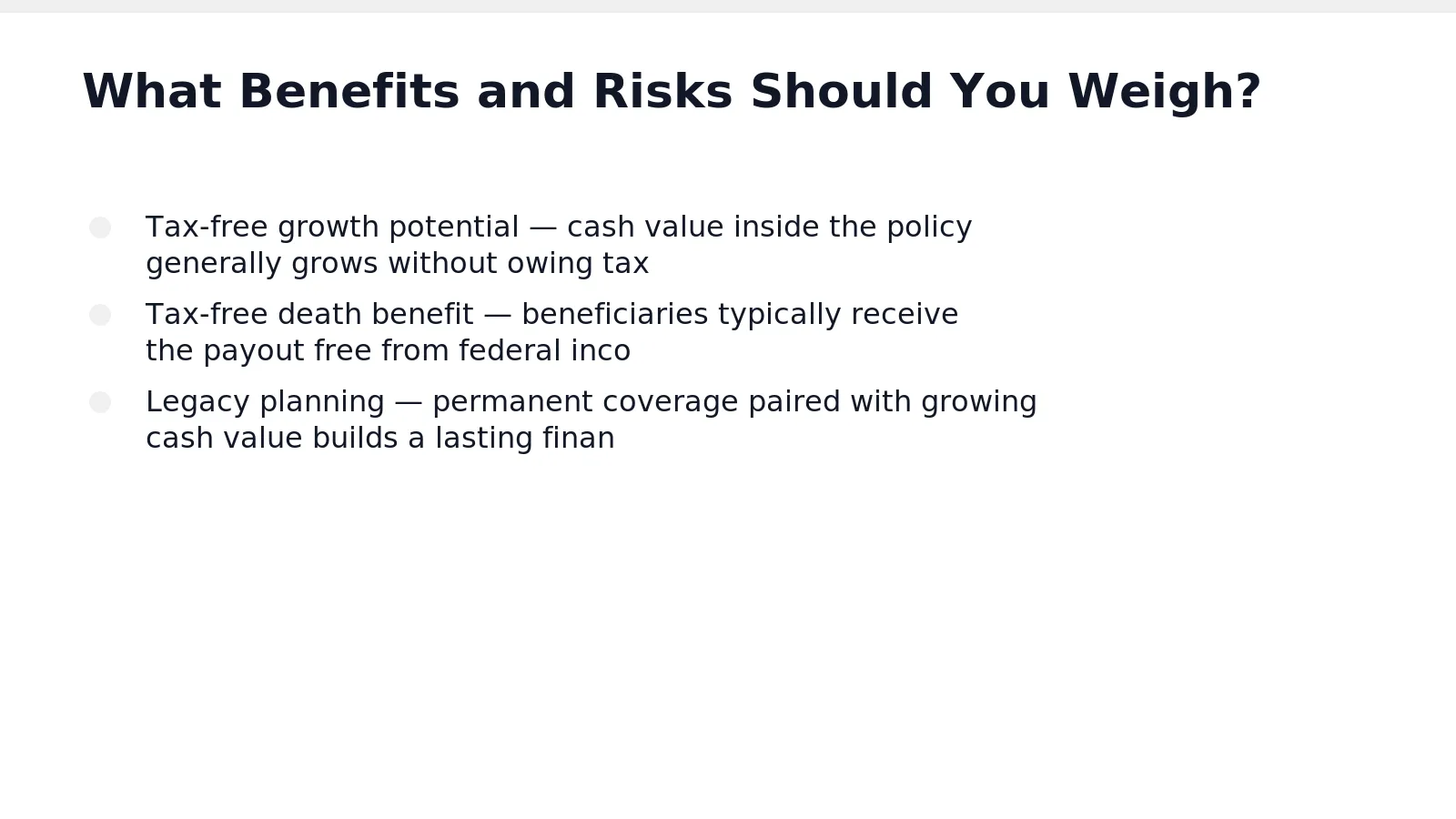
What Benefits and Risks Should You Weigh in Indexed Universal Life Insurance?
Weighing indexed universal life pros and cons matters before you commit: the combination of growth potential and tax advantages makes indexed universal life a compelling option for many families, however, understanding the associated risks is equally important. Caps on index-linked returns limit maximum gains, while the complexity involved in tracking market indices requires clear education.
Key benefits include:
- Tax-free growth potential: Cash value accumulation generally grows without generating taxable income each year.
- Tax-free death benefit: Beneficiaries typically receive death benefits exempt from federal income taxes.
- Legacy planning: Permanent coverage and growing cash value provide a durable financial foundation to support loved ones long-term.
For families seeking transparent comparisons, reviewing life insurance and term life insurance alternatives can provide clarity about the value proposition of indexed universal life insurance.
Is IUL the Right Fit for Every Family?
Indexed universal life insurance is not universally ideal. Households prioritizing simplicity and immediate, low-complexity coverage might favor simplified issue or term life insurance to avoid the indexing and crediting mechanisms inherent in IUL. Business owners, on the other hand, often find IUL policies valuable when bundled with strategies like Key Person insurance and Buy-Sell funding, which protect both business interests and personnel.
What Risks Come With Index-Linked Growth?
Although floors protect against losses, caps limit upside growth, so during strong market years, gains are constrained. The complexity of index crediting, participation rates, and dynamic premium options can also be challenging to navigate without expert guidance. Clients benefit from working with knowledgeable agents who provide clear explanations tailored to their specific policies.
Families and business owners throughout Fairfax, Loudoun, Arlington, and the broader DC Metro region find that assessing these trade-offs with VIP Insures leads to decisions that align with their long-term financial goals.
How Does IUL Compare to Whole Life? An Indexed Universal Life Insurance Perspective
Indexed universal life insurance stands out from whole life mainly due to its cash value growth potential tied to market indices, albeit at the cost of additional complexity. Whole life offers steady, guaranteed cash value increases and fixed premiums, ideal for those who value predictability. An iul policy guide highlights that while IUL can provide higher growth during favorable markets, it comes with more variables, fees, and non-guaranteed returns.
Choosing between them hinges on whether a household prefers potential upside with volatility or stable, fixed growth. Whole life typically appeals to families desiring simplicity and fixed premiums, whereas indexed universal life suits those willing to accept variability for the opportunity of stronger cash value appreciation.
Is IUL Riskier Than Whole Life?
IUL carries greater variability because its cash value depends on market index performance, unlike whole life’s fixed-rate accumulation. However, embedded safety nets such as the floor provide downside protection. Families seeking straightforward financial planning often opt for whole life to avoid market linkage. For applicants aged 45 to 85, VIP Insures also offers guaranteed issue life insurance requiring no medical exams, a simpler alternative for those focusing on final expense insurance without underwriting complexity.
Not every family benefits from index-linked growth or fixed whole life plans; VIP Insures builds fully customized options based on income, legacy goals, and protection needs throughout Northern Virginia and the DC Metro area.
Is IUL Right for Your Northern Virginia Family? Insights from an Indexed Universal Life Expert
Indexed universal life insurance is often a middle ground between growth potential and permanent protection. The best outcomes depend on individual goals such as legacy preservation, business continuity, or long-term cash value growth linked to market performance rather than fixed accumulation. In Northern Virginia, families value local expertise that understands regional financial challenges and opportunities.
Who Typically Benefits Most from an IUL Policy?
Business owners and entrepreneurs frequently find indexed universal life insurance instrumental in both protecting their business interests and planning for wealth accumulation. Additionally, individuals seeking flexible, lifelong coverage coupled with the chance for market-linked cash value growth benefit from IUL's adaptability. This combination is especially advantageous for families planning decades ahead with evolving income and priority shifts.
What Should Fairfax, Loudoun, or Arlington Families Consider Before Buying Indexed Universal Life?
Local, personalized guidance is critical. VIP Insures’ Sterling, VA base allows agents to provide informed advice tailored to the specific financial realities of Fairfax County, Loudoun County, Arlington, and the broader DC Metro area. The small, two-agent team ensures every client receives unhurried, direct conversations instead of impersonal call centers, making it easier to understand whether an iul policy guide fits their unique situation.
FAQ
What is indexed universal life insurance?
Indexed universal life insurance is a permanent life insurance policy that provides death benefit protection along with a cash value component whose growth is linked to the performance of a specified market index. This structure combines protection, tax-advantaged growth potential, and premium flexibility in one product.
Author / Expert Reviewer Bio
Eunice Johnson is a licensed insurance professional with over 15 years of experience serving clients in Northern Virginia, the Washington DC metro area, and nationwide. Specializing in indexed universal life insurance and other permanent protection products, Eunice offers personalized guidance and has helped hundreds of families and business owners secure tailored solutions aligned with their financial goals. Her expertise and client-focused approach make her a trusted authority on life insurance planning in the region.
Conclusion
Indexed universal life insurance offers a balanced approach to coverage, blending growth potential tied to market performance with downside protection through a guaranteed floor. Its flexibility in adjusting premiums and death benefits ensures the policy can accommodate life’s evolving circumstances. Deciding if it’s right for you involves careful consideration of your timeline, risk tolerance, and financial objectives. Taking the time to understand indexed universal life insurance thoroughly will empower you to make informed decisions for your long-term financial security.
Contact VIP Insures
- 📞 Phone: (571) 444-8475
- ✉️ Email: [email protected]
- 📅 Consultation: Meet with Eunice
- 🌐 Website: vipinsures.com
- 📍 Service Area: Northern Virginia, Washington DC Metro area, and nationwide (Service Area Business — no physical street address)